


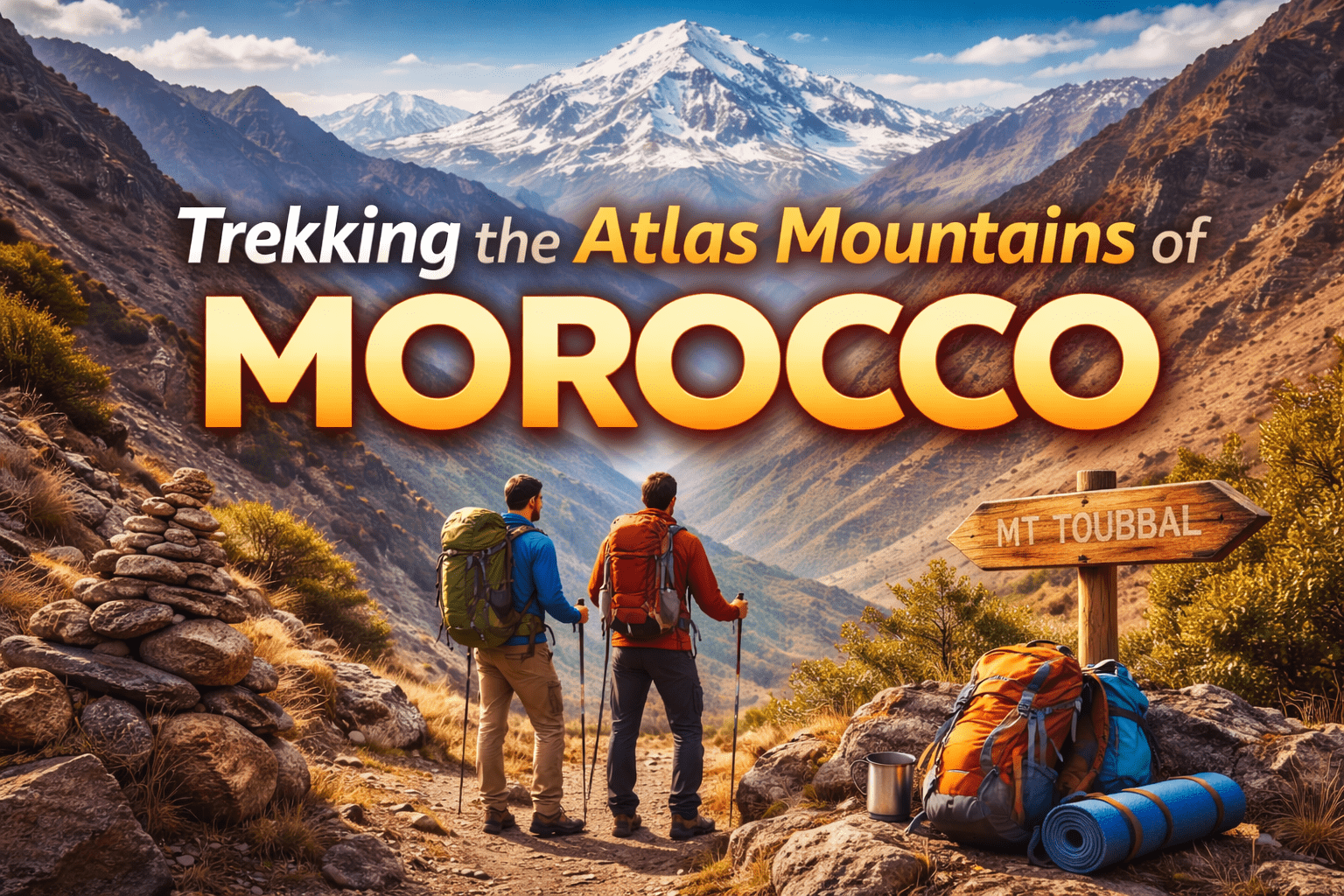
I didn’t plan this trip very carefully. That is the honest truth. I had three weeks off, a modest savings buffer, a backpack that’s seen better days, and a map of Morocco that I’d been staring at for two years. So when a friend casually mentioned Imlil over coffee, I booked my flight the same evening.
Best impulsive decision I’ve ever made.
The Atlas Mountains of Morocco had been quietly sitting on my bucket list since I saw a single photograph — a lone trekker on a ridge, the Sahara glowing orange in the far distance, a Berber village clinging to the slope below. That image promised something I couldn’t name. After spending eight days in those mountains, I think I can name it now: it promised complete, total, unapologetic aliveness.
Geographical know-how about Morocco
The Atlas mountain provide Morocco with long rocky spines. With peaks rising to above 4000 metres, it boasts a series of several trekking routes. The foothills of these mountains are home to Berber people, an ethnic group who lives in the mountain of Morocco from many centuries. The landscape changes form mountainous to dry from south to east with great Sahara Desert. This desert offers an unparalleled diversity that is enduringly fascinating. If you want to experience the serenity and sublimity of golden sand dunes, then Sahara Desert is worth of traveling. The Atlas range itself acts as a barricade between the lower Sahara Desert region and the northern rolling Middle Atlas and RIF mountains, which means it catches both the dryness and greenery to the regions. In addition to that, Morocco has long Atlantic coastline, which conjures vision to endless paths of golden sand ripening under a tropical sun and sweet colored sky.
Cultural Influences in Morocco
Located fewer than 10 miles from the coast of Spain, Morocco blends the unique identity of Berber, European and North African culture. The people consists of small ethnic groups descended from the groups of Arabic and Islamic culture. As a result, more than 99 percent of Moroccans are Muslims and remaining one percent are either Jewish or Christian. This country takes classic Arabic and Tamazight as an official language. Classic Arabic are limited to few people, however, Moroccan Arabic are preferred over other linguistic dialect.
The Journey Begins — Landing in Marrakech

Most trekkers to the Atlas Mountains start in Marrakech. So did I. I gave myself one day in the city — just enough to get lost in the medina, eat too many pastilla flakes, and watch the Djemaa el-Fna square erupt into its nightly chaos.
The next morning, I hired a shared taxi to Imlil — roughly 65 km from Marrakech, about an hour and a half drive. The road winds steeply up through the Mizane Valley, and you can literally watch the landscape transform. One moment you’re in a dusty Moroccan suburb, and then suddenly — without ceremony — the mountains take over. Red rock walls rise on either side. Walnut trees line the road. And the air gets cooler, cleaner, sharper.
By the time I stepped out of the taxi in Imlil, I already felt like a different person.
| Detail | |
|---|---|
| Base Village | Imlil — 1,740 m |
| Mount Toubkal Height | 4,167 m above sea level |
| Trek Duration | 2 to 6 days (route dependent) |
| Distance from Marrakech | ~65 km · 1.5 hrs |
Imlil — Morocco’s “Little Chamonix”
French visitors once nicknamed Imlil “Little Chamonix,” and once you arrive, you understand why. It has that same mix of mountain town energy and adventure-seeker quiet. Mules loaded with supplies navigate narrow alleys. Guides sit at tea houses comparing routes. The air smells like woodsmoke and fresh bread.
I spent the evening there, staying in a simple gîte — a family-run guesthouse that cost almost nothing and gave me everything: a warm wool blanket, a tagine with soft-boiled eggs and olives, and a view of the mountain I was about to climb from my small window.
I hired a local guide named Hassan. He was born in Imlil, knows every trail by memory, and speaks four languages. His quiet confidence on the mountain is something I will never forget. If you’re doing the Toubkal trek, hiring a certified local guide isn’t just recommended — it’s mandatory, and completely worth it.
Day One — Imlil to the Toubkal Refuge
We set off at 7 AM. The first section of the trail follows the Mizane Valley through apple and walnut orchards. It’s gentle enough that you’re fooled into thinking this is easy. Then the path starts to climb — and it doesn’t stop.
After about five hours of trekking, we reached the Toubkal Refuge at 3,207 metres. My legs had opinions about this. Loud opinions. But every time I stopped to catch my breath, I turned around and forgot what pain felt like. The valley below was painted in layers — green fields giving way to red rock, then the hazy brown plains of the Marrakech region stretching into the horizon.
That evening at the refuge, I shared a long table with trekkers from Poland, Japan, and two brothers from Casablanca doing the climb for the third time. We ate harira soup and crusty bread. Someone had a small speaker. It was, unexpectedly, perfect.
Day Two — The Summit Push on Mount Toubkal
We left at 5:30 AM. Stars still out. Temperature around 2°C. I layered everything I had and followed Hassan’s headlamp up the rocky slope.
The final ascent to the Toubkal summit is not technically difficult — there’s no roping or climbing gear needed in summer. But it is relentlessly steep, and at that altitude (4,167 metres), every step costs more oxygen than you expect. My lungs were negotiating hard.
And then — the summit. I can’t write this part without tearing up a little, honestly. You stand there at the highest point in all of North Africa, the Sahara Desert glowing faintly to the south, snow-capped ridges stretching in every direction, and the silence is so complete it almost has a sound.
I stood up there for twenty minutes. Hassan took a photo. I cried, very embarrassingly, and didn’t care at all.
“At 4,167 metres — the highest point in North Africa — I understood why people spend their whole lives chasing summits. It isn’t about the view. It’s about proving to yourself that you can.”
Beyond Toubkal — What Else I Explored
I gave myself four extra days after Toubkal, and this is where the Atlas Mountains really surprised me. The summit gets all the glory, but the surrounding landscape and culture are what haunt you afterward.
-
The Azzaden Valley — I hiked down into this quiet valley and stayed overnight in a tiny village. No tourists. A family fed me couscous and mint tea. Their kids showed me their school notebooks. That evening was worth the whole trip by itself.
-
Ourika Valley — A beautiful, lush side trip with waterfalls and Berber market villages. Perfect for a slower, gentler day after the summit fatigue.
-
Todra Gorge (day trip) — Two hours east, the 300-metre-deep limestone gorge is jaw-dropping. I did a half-day hike into the upper gorge and felt comfortably insignificant.
-
Aït Benhaddou Kasbah — The UNESCO World Heritage Site near Ouarzazate, famous for its appearances in films like Gladiator. A short detour that adds serious historical texture to your Atlas journey.
-
Berber village walks around Amezmiz — For those with less time or fitness, the Amezmiz base offers gentle walks through terraced farmland and authentic Berber life without any serious altitude gain.
Best Time to Trek the Atlas Mountains
Timing matters a lot in the Atlas. I went in late October and the conditions were almost perfect — cool mornings, crisp clear skies, very few crowds on the trails.
Best
Spring · Mar – May
Wildflowers bloom. Streams run full. Green valleys, moderate temps, fewer crowds. Ideal for multi-day treks and Berber village routes.
Autumn · Sep – Nov
Clear skies, harvest season energy, comfortable temperatures. My personal favourite. The light on the mountains in October is extraordinary.
Good
Summer · Jun – Aug
Hot in valleys, but high altitude stays 20–30°C. Best time for Toubkal summit. Start early to beat the midday sun. Carry plenty of water.
Challenging
Winter · Nov – Feb
Snow covers high trails. Toubkal requires crampons and winter gear. Lower valleys remain accessible. Stunning if you’re experienced and prepared.
The Best Things About Trekking the Atlas Mountains
People ask me what makes the Atlas Mountains different from other treks. Here’s my honest list.
The Berber culture is not a backdrop — it’s the whole point. These mountains are lived in. Farmers work terraced fields at 2,000 metres. Shepherds guide flocks across passes. You are a guest in someone’s ancestral landscape, and that weight makes every step feel meaningful.
The accessibility is unreal. You can fly into Marrakech, take a 90-minute taxi to Imlil, and be walking a trail that feels genuinely wild within the same morning. No extreme logistics, no weeks of preparation.
The diversity of terrain. In a single week, I walked through fruit orchards, high alpine rock fields, limestone gorges, and red desert plains. The Atlas doesn’t have one face — it has dozens.
The hospitality. Mint tea appears at every gîte, every refuge, every Berber home you pass. I was never treated like a tourist. I was always treated like a guest.
Practical Tips Before You Go
Things I wish I knew before trekking the Atlas Mountains
- Hire a certified local guide — mandatory for Toubkal, invaluable everywhere else
- Book your gîte or refuge in advance, especially in spring and autumn peak season
- Carry cash (Moroccan Dirhams) — most mountain accommodation doesn’t accept cards
- Pack layers — temperature swings 15–20°C between dawn and midday at altitude
- Altitude hits harder than you expect above 3,000m — ascend slowly, drink water constantly
- Trekking poles are not optional above the refuge — they save your knees on the descent
- Learn three words of Tachelhit (Berber): “Azul” (hello), “Tanmirt” (thank you), “Imik” (a little). You’ll get smiles that last all day
Would I Go Back?
Without a second’s hesitation. I’ve already started researching the M’goun Circuit — a multi-day route through the central Atlas that gets a fraction of the visitors Toubkal draws, but delivers some of the finest mountain scenery in Morocco.
The Atlas Mountains don’t care how experienced you are. They welcome first-timers and seasoned alpinists with equal generosity. They give you exactly what you’re willing to bring to them — effort, curiosity, and a genuine openness to being humbled.
If you’re sitting somewhere with a travel itch you can’t scratch, staring at your laptop trying to decide where to go next — I’m telling you, from someone who has trekked in the Himalayas, the Andes, and the Scottish Highlands — book Morocco. Go to Imlil. Start walking.
Other Unique Destination for Trekking
Back to the point! When you are on a trip to Morocco, there are several things to explore. Its’ impressive natural diversity offers visitors from relaxed beaches to mountain escapes and everything. The Atlas Mountains has blessed this country with some of the world’s most dramatic and beautiful mountains. Trekking attracts major tourist from worldwide every year. Beginners can enjoy gentle forays in the Atlas Mountains whereas experienced hikers can try snow-ravaged tops in winters. Here, we have listed some of most thrilling mountains to trek in Morocco:
Toubkal:
Jebel Toubkal, also known as the highest peak of North Africa, heights to 4167m into the central High Atlas range, dishing most captivating views of various land profiles in Morocco. This quasi-mythical mountain rewards trekkers with challenging altitude for trekking and trawling in there. During summer months, the moderate temperature creates a favorable atmosphere to trek in two to three days, whereas winters are bit challenging. The trails are heaped with snow, restricting visitors to trail in winters.
Jebel Saghro:
Jebel Saghro Mountains lies in the Anti-Atlas range of Morocco. When the temperature dips down in High Atlas Mountains, the climatic condition in Saghro Mountains gives a wintery escape for the trekkers. The temperature remains milder, offering a passable passage without any difficulty as Toubkal’s snow trails.
M’Goun massif:
M’Goun massif traverse through the Central High Atlas range, viewing scenic beauty of nearby valleys and rivers. This peak is 4071 m high, which means visitors can comfortable stay and relaxed on the top and enjoy the scenery for long hours. One can get an exotic view of wild flowers and dramatic snow rivers flowing through the valleys, where local Berbers live.
Sirwa Massif:
Unlike the High Atlas Mountains, the anti-atlas mountains such as Sirwa Massif are less heralded mountains in the south of Morocco. However, some peaks are tempting for beginners and experienced trekkers too. Trek enthusiasts can climb mountain Sirwa, a 3304-meter-high volcanic mountain in two days, and then trace the lower Berber valleys and their steeply terraced fields on the round-trip from Taliouine.